(English version below)
In Toruń, waar de Wisła zwart wegtrekt onder een hemel die maar half wakker is, bouwen Gavron en Jh sinds 2023 aan een tempel van gebeente. Het Poolse duo, ook actief binnen Occultum, liet zich vorig jaar horen met Stare into the Blackest Depths of Hell, een debuut dat zich met volle overtuiging in de tweede golf wierp. Op Ex Ossibus Templum Ei Erigemus liggen die wortels nog ergens onder de grond, maar wat erboven groeit heeft een grilliger, schever silhouet gekregen, alsof het bouwwerk zichzelf niet helemaal wil tonen.
Tremoloriffs blijven een wapen, maar ze worden voortdurend opengehaald door dissonante lijnen die de muziek uit haar vorm trekken. Wanneer Black Witchcraft versnelt, gebeurt dat met een razernij die geen adem gunt. Drums jagen door, gitaren schuren tegen elkaar tot de dissonantie eruit druipt. De stem weigert één gezicht. Soms spuugt ze recht vooruit, dan slaat ze om in hysterische, ijzige kreten die eerder uit pijn lijken losgerukt dan uit een keel.
Maar snelheid is niet het enige waar Ex Ossibus Templum Ei Erigemus op draait. Black Witchcraft trekt het tempo geregeld terug tot een dreigende middentred, of laat de muziek nog verder zakken om haar daarna weer open te rijten. Die verschuivingen maken de nummers rusteloos, alsof ze nergens willen blijven hangen. Tremolo en dissonantie botsen en grijpen elkaar vast, riffs worden langer aangehouden dan comfortabel is. Elke terugkeer van dezelfde riff komt anders binnen, tot herhaling zelf begint te knagen.
Midden in Temple of Bones opent zich plots een andere ruimte. De razernij valt weg en uit de traagheid rijst een koor op, alsof achter gesloten deuren een zwarte mis haar hoogtepunt bereikt. Even lijkt de titel van de plaat tastbaar, alsof de tempel rond de luisteraar wordt opgetrokken. Maar het moment wordt meteen dichtgeslagen. Het tempo schiet omhoog, een gierende solo scheurt door het bouwwerk heen, en die andere ruimte verdwijnt alsof ze nooit bestaan heeft.
Wanneer de composities langer worden, krijgt die veranderlijkheid vrij spel. Snelle uitbarstingen zakken naar mid-tempo, vertragen verder en worden opnieuw voortgejaagd, terwijl de vocalen mee muteren van agressie naar hysterie. Naar het einde toe krijgt repetitie meer gewicht. Dezelfde riff keert zo lang terug tot ze zich vastbijt, en de drums blijven razen alsof ergens een grens moet sneuvelen. De lange afsluiter laat die beweging breed uitwaaieren en weigert een uitweg. Wat traag uit de aarde omhoogkomt, wordt gaandeweg een koortsige stroom die de contouren van de riffs aantast.
De tweede golf die op het debuut nog door de gangen trok, is hier tot een schim herleid. Black Witchcraft heeft haar oude geraamte niet verbrijzeld. Tremolo, rauwheid en directe agressie verraden nog altijd waar de fundamenten liggen. Maar uit die beenderen wordt nu iets opgetrokken waarvan de vorm nauwelijks nog gehoorzaamt aan het geraamte waaruit het ontstond.
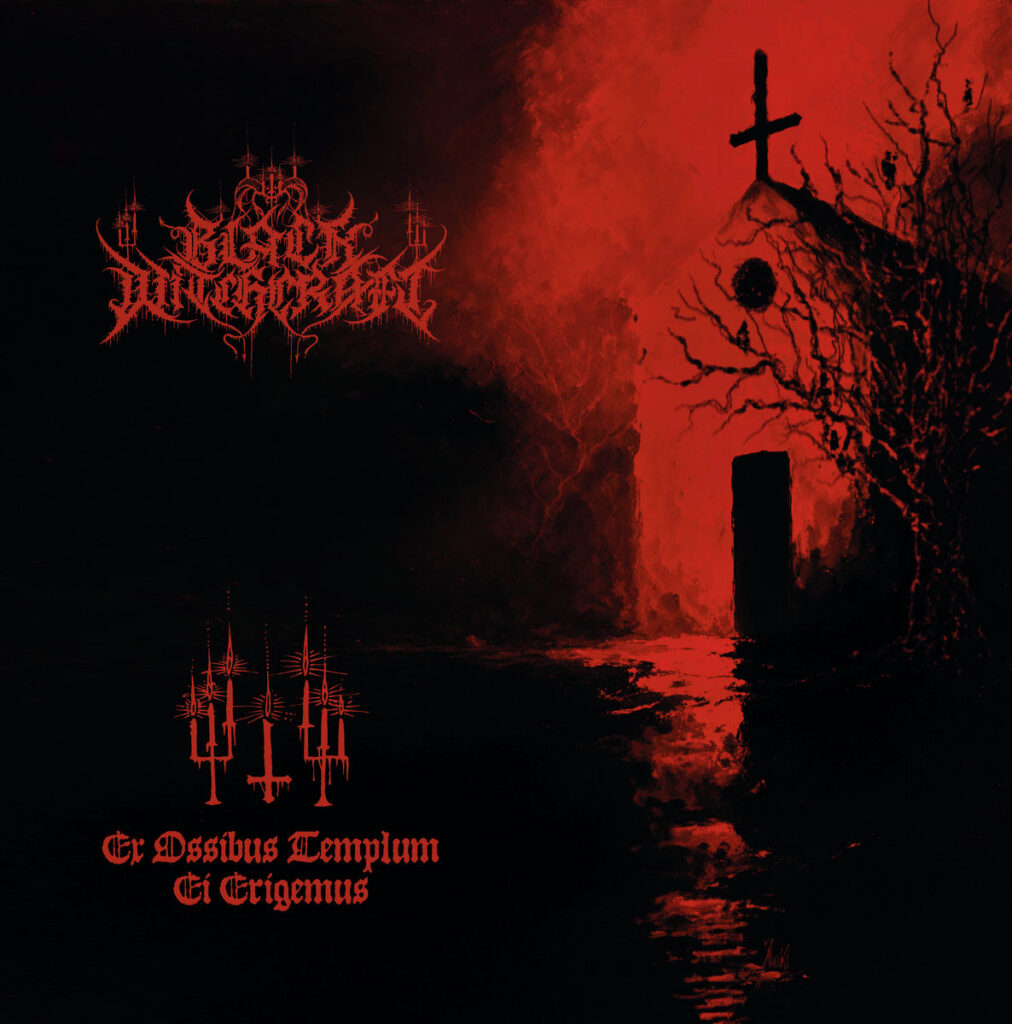
Het hoesontwerp vangt die verschuiving. Een vervallen kapel tussen kaal geboomte, een omgekeerd kruis erboven, een zwarte deuropening waar licht ophoudt. Ex Ossibus Templum Ei Erigemus staat op diezelfde drempel. De beenderen van het verleden liggen nog onder de vloer, maar achter het altaar heeft iets anders bezit genomen van de tempel.
88/100
⸸ Blackie ⸸
English version
In Toruń, where the Vistula flows black beneath a sky only half awake, Gavron and Jh have been building a temple of bones since 2023. The Polish duo, also active within Occultum, made themselves heard last year with Stare into the Blackest Depths of Hell, a debut that threw itself wholeheartedly into the second wave. On Ex Ossibus Templum Ei Erigemus, those roots still lie somewhere beneath the ground, but what grows above them has taken on a more jagged, crooked silhouette, as though the structure refuses to reveal itself completely.
Tremolo riffs remain a weapon, but they are constantly torn open by dissonant lines that pull the music out of shape. When Black Witchcraft accelerates, it does so with a fury that leaves no room to breathe. Drums charge onwards, guitars scrape against each other until dissonance seems to drip from them. The voice refuses a single face. At times it spits its venom straight ahead, only to erupt into hysterical, icy shrieks that seem torn from pain rather than from a throat.
Yet speed is not the only force driving Ex Ossibus Templum Ei Erigemus. Black Witchcraft regularly pulls the tempo back into a menacing mid-paced tread, or lets the music sink even further before ripping it open again. These shifts make the songs restless, as though they refuse to linger anywhere for long. Tremolo and dissonance collide and clutch at one another, while riffs are sustained longer than feels comfortable. Each return of the same riff strikes differently, until repetition itself begins to gnaw.
Halfway through Temple of Bones, another space suddenly opens. The fury falls away and a choir rises from the slowness, as though a black mass behind closed doors has reached its climax. For a moment, the album title seems almost tangible, as if the temple were being erected around the listener. But the moment is immediately sealed shut. The tempo surges, a howling solo tears through the structure, and that other space disappears as though it had never existed.
As the compositions grow longer, that restlessness is given free rein. Fast eruptions sink into mid-tempo, slow down further and are driven forward once more, while the vocals mutate with them from aggression into hysteria. Towards the end, repetition gains greater weight. The same riff returns until it sinks its teeth in, while the drums keep raging as though some boundary has to be broken. The lengthy closing track allows this movement to spread wide and refuses to offer an escape. What rises slowly from the earth gradually becomes a feverish current that eats away at the contours of the riffs.
The second wave that still wandered the corridors of the debut has been reduced here to a shadow. Black Witchcraft has not shattered its old skeleton. Tremolo, rawness and direct aggression still betray where the foundations lie. But from those bones, something is now being erected whose shape barely obeys the skeleton from which it arose.
The cover artwork captures that shift. A ruined chapel among barren trees, an inverted cross above it, a black doorway where the light ends. Ex Ossibus Templum Ei Erigemus stands upon that same threshold. The bones of the past still lie beneath the floor, but behind the altar, something else has taken possession of the temple.
88/100
⸸ Blackie ⸸
Under the seal of Under the Sign of Garazel Productions
Conjured on September 4 2026