(English version below)
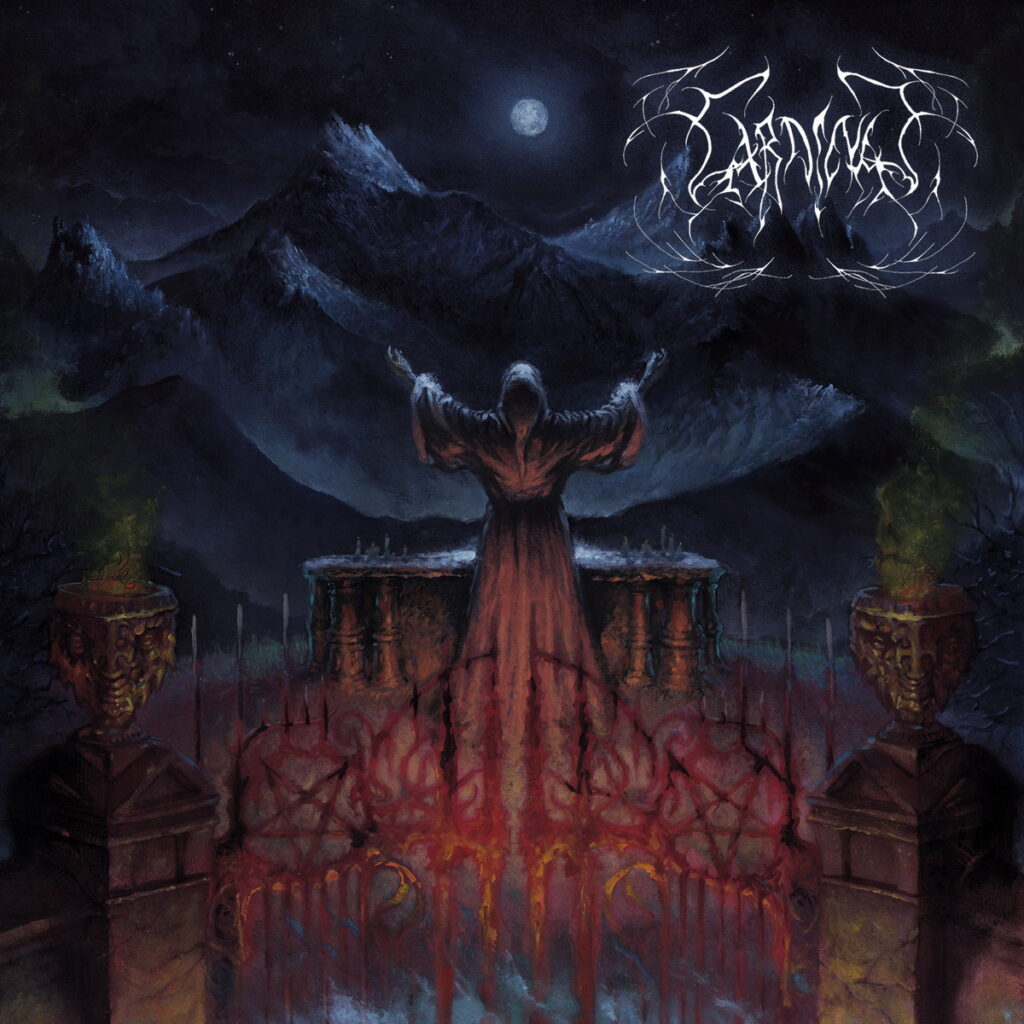
De schaduwen boven San Francisco zijn samengeklonterd tot een tastbare, verstikkende duisternis, een duisternis die ook de hoes van Nocturne doortrekt: een eenzame gedaante die de armen heft voor een altaar, opgetrokken tussen ijskoude bergtoppen en een vuurrood pentagram dat de aarde eronder lijkt open te scheuren. Met deze door Sonorous Night uitgebrachte debuutplaat opent Cardinal de poorten naar een aardedonker rijk waarin de geest van de symfonische black metal uit de jaren negentig opnieuw rondwaart. Rauw en ongefilterd, alsof de plaat rechtstreeks uit de aarde is opgegraven.
Zes volwaardige nummers vormen het hart van Nocturne, met daartussen het korte ambientintermezzo Beyond the Iron Gates en aan het einde de symfonische duisternis van The Deceiver’s Mark. Vooral de synths drukken hun stempel op het geluid: monumentaal, maar de gitaren blijven altijd hoorbaar. Cardinal laat beide naast en door elkaar bewegen: ijzige riffs behouden hun scherpte terwijl de synths er een veel grotere, nachtelijke ruimte rond optrekken. Het resultaat is atmosferisch en bij momenten heerlijk zweverig, terwijl de rauwe kern van de plaat overeind blijft.
De synths eisen veel ruimte op: ze sturen de sfeer actief mee en geven Nocturne zijn uitgesproken symfonische karakter. De riffs blijven daaronder duidelijk aanwezig en vormen de ruggengraat waarrond de synths zich slingeren. Soms klinken die laatste plechtig en groots, even later ijl en zwevend, alsof de muziek zich even losmaakt van de aarde.
Daar ligt een groot deel van de kracht van de plaat. De oude Noorse geest is onmiskenbaar aanwezig, zowel in de kille gitaarlijnen als in de schrale, verbeten krijsen van Tharn. Op die fundamenten trekt Cardinal een eigen duister landschap op. De krijsen zijn scherp, kil en venijnig en snijden dwars door de symfonische lagen heen. Onder dat alles houden drums en de opvallend voelbare bas de plaat stevig aan de aarde gekluisterd.
De productie houdt dat evenwicht overeind: Nocturne klinkt rauw genoeg om zijn tanden te behouden, met voldoende ruimte tussen de instrumenten. De synths waaieren breed uit, de gitaren blijven schuren en ook de bas verdwijnt nergens onderaan in de mix. Zo klinkt de plaat groots, met vuil en kilte diep in de wortels.
Die wisselwerking geeft Nocturne een merkwaardige diepte. De plaat kan ruw uithalen en kort daarna openbreken in passages waarin de muziek haast gewichtloos door een nachtelijke leegte lijkt te zweven. Het korte ambientintermezzo versterkt dat gevoel en vormt een natuurlijke breuk in de plaat. De afsluitende symfonische outro trekt de poorten langzaam weer dicht.
Voor een debuut klinkt Nocturne opvallend compleet. Cardinal spreekt de oude taal van de jaren negentig met voldoende overtuiging om er een eigen stem in te leggen. Rauwe black metal, duistere melodieën en prominent aanwezige synths worden samengesmeed tot een eerste langspeler die meteen overtuigt.
85/100
⸸ Blackie ⸸
English version
The shadows above San Francisco have congealed into a tangible, suffocating darkness, one that also seeps through the cover of Nocturne: a solitary figure raising its arms before an altar, erected between freezing mountain peaks and a fiery red pentagram that seems to tear open the earth beneath it. With this debut album, released by Sonorous Night, Cardinal opens the gates to a pitch-black realm where the spirit of nineties symphonic black metal once again roams. Raw and unfiltered, as if the record had been unearthed directly from the soil.
Six full songs form the heart of Nocturne, with the short ambient interlude Beyond the Iron Gates placed among them and the symphonic darkness of The Deceiver’s Mark waiting at the end. The synths in particular leave their mark on the sound: monumental, yet the guitars always remain audible. Cardinal lets both move alongside and through each other: icy riffs retain their sharpness as the synths open up a much wider, nocturnal space around them. The result is atmospheric and at times wonderfully dreamlike, while the raw core of the record remains firmly intact.
The synths claim plenty of space: they actively shape the atmosphere and give Nocturne its pronounced symphonic character. Beneath them, the riffs remain clearly present, forming the backbone around which the synths coil. At times they sound solemn and grand, only to become airy and drifting moments later, as if the music briefly detaches itself from the earth.
A large part of the album’s strength lies there. The old Norwegian spirit is unmistakably present, both in the cold guitar lines and in Tharn’s gaunt, bitter shrieks. Upon those foundations, Cardinal raises a dark landscape of its own. The shrieks are sharp, cold and venomous, cutting straight through the symphonic layers. Beneath it all, the drums and remarkably tangible bass keep the record firmly anchored to the earth.
The production maintains that balance: Nocturne sounds raw enough to keep its teeth, with sufficient space between the instruments. The synths spread out wide, the guitars continue to scrape and even the bass never disappears somewhere at the bottom of the mix. The record sounds grand, with dirt and cold buried deep within its roots.
That interplay gives Nocturne a peculiar depth. The record can lash out harshly and shortly afterwards open into passages where the music seems to drift almost weightlessly through a nocturnal void. The brief ambient interlude reinforces that feeling and forms a natural break within the album. The closing symphonic outro slowly draws the gates shut again.
For a debut, Nocturne sounds remarkably complete. Cardinal speaks the old language of the nineties with enough conviction to carve its own voice into it. Raw black metal, dark melodies and prominent synths are forged into a debut full-length that makes its mark immediately.
85/100
⸸ Blackie ⸸
Under the seal of Sonorous Night Productions
Conjured on September 20 2026